There is an old, unwritten rule in American politics that every seasoned operative knows by heart: never spike the football before you cross the goal line. When political hopefuls let their egos outrun the actual voter count, the resulting fallout is never just an awkward defeat. It turns into an instant, self-inflicted public humiliation that echoes across the digital landscape forever.
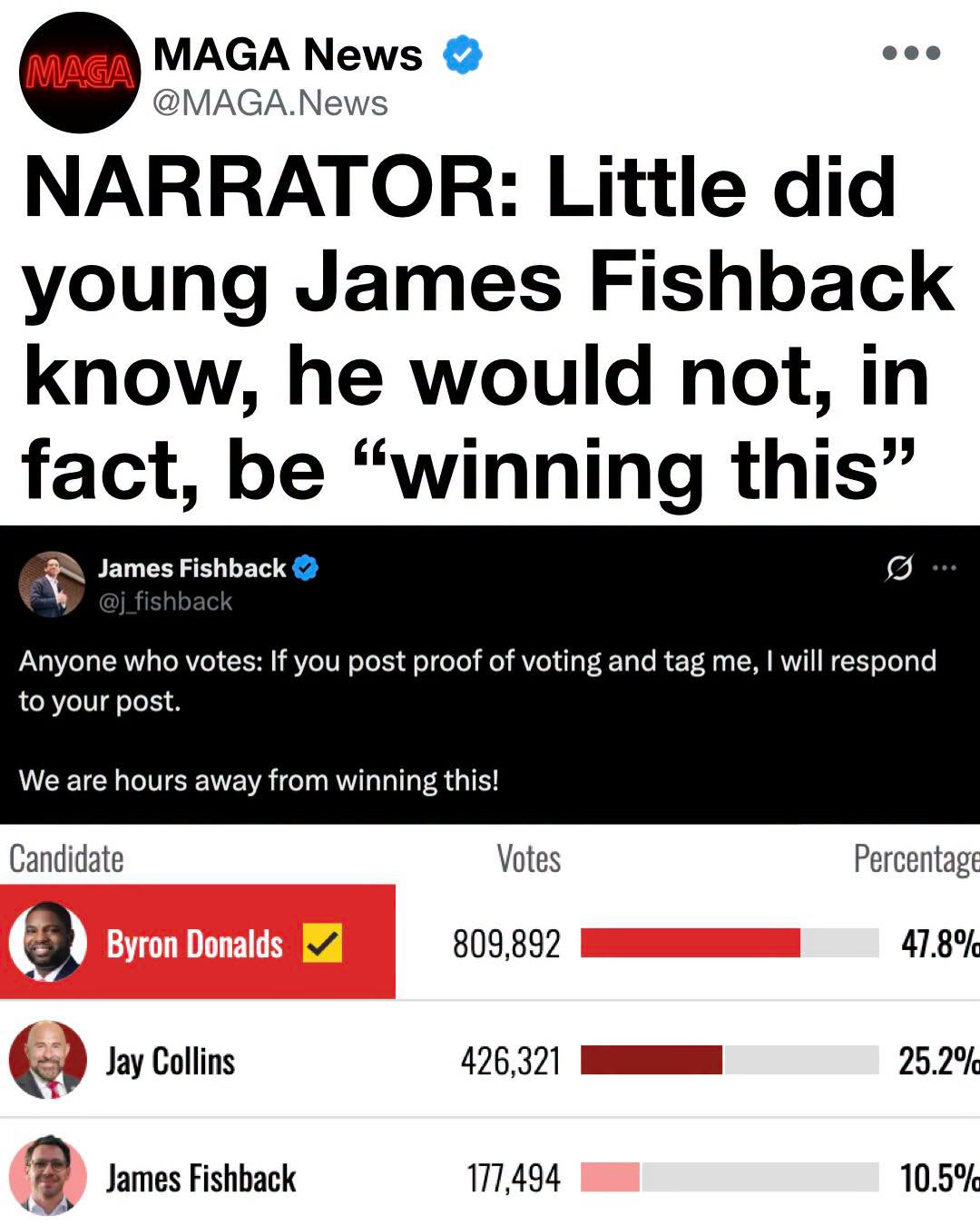
Few recent spectacles illustrate that brutal truth quite like the unmitigated disaster of James Fishback’s campaign implosion. Taking to social media with supreme, unearned swagger, the candidate essentially declared that a massive victory was mere hours away. It was the kind of breathless, chest-thumping prediction that immediately set the stage for an all-time classic political faceplant.
When the actual ballots were tabulated, the fantasy evaporated in an instant. Primary voters did not just reject the manufactured hype; they delivered a crushing, undeniable verdict that sent Fishback stumbling into a distant, humiliating third place. Scraping by with barely double digits, the self-proclaimed incoming victor became the punchline to a joke he wrote entirely by himself.
Meanwhile, Congressman Byron Donalds put on an absolute masterclass in real-world political dominance. Donalds did not rely on manufactured viral stunts or performative digital posturing to manufacture relevance. He went straight to the grassroots base, racked up overwhelming support across the board, and crushed the competition by a staggering, lopsided margin.
The stark contrast between the two campaigns exposed the massive, growing chasm between online delusions and real-world voter sentiment. While online grifters and clout-chasers were busy convincing themselves that likes and retweets equal political power, real voters were quietly lining up at polling precincts. When the dust settled, the cold, hard numbers laid bare an embarrassing truth that no spin doctor could ever hide.
Premature victory declarations have a notorious habit of aging like milk in the blazing Florida sun. When a candidate spends the final hours of an election acting like coronation day has arrived, every single vote counted against them becomes an indelible badge of embarrassment. It is the ultimate unforced error in modern campaigning, driven entirely by hubris and an utter detachment from reality.
Fishback’s dramatic miscalculation serves as a textbook case study in what happens when a campaign breathes in too much of its own digital exhaust. Surrounded by sycophants in an online echo chamber, it is easy to mistake algorithmic amplification for genuine political momentum. But algorithms do not walk into voting booths, and digital cheerleaders rarely represent the hardworking men and women who decide American elections.
The atmosphere surrounding the Donalds camp, by contrast, was grounded in the relentless, steady work of building real coalitions. Donalds has spent years cultivating genuine trust with the conservative grassroots, proving himself on the national stage as an articulate, fearless, and principled leader. That reputation was forged through real battles, not manufactured Twitter spaces and inflammatory clickbait.
As the election day hours ticked away, Fishback’s confidence only seemed to grow louder and more detached from the ground game. Followers were treated to triumphant declarations, painting a picture of an inevitable political revolution that was about to take the district by storm. Anyone paying attention to the real pulse of the community knew the narrative was entirely divorced from the facts.
Then came the moment of truth that every political bluffer dreads: the precinct results started dropping. Within minutes of the first returns being published, the entire house of cards collapsed into dust. The gap between Donalds and the rest of the pack was not just wide; it was an absolute, insurmountable chasm that widened with every batch of counted ballots.
The Illusion of the Digital Echo Chamber
Watching the numbers roll in was a masterclass in political reality checking. Byron Donalds was running up massive, blowout totals across virtually every key demographic and precinct, demonstrating total organizational command. Fishback, meanwhile, was left stranded in the single-to-low-double-digit wasteland, completely rejected by the very voters he claimed to be leading.
The sheer scale of the defeat turned Fishback’s earlier boastfulness into instant comedic fodder across the political spectrum. Screenshots of his pre-election victory promises circulated at lightning speed, juxtaposed directly against the unforgiving canvas of the final election board tally. In the modern era of the internet, premature celebrations do not just fade away; they are archived, memed, and remembered forever.
“Primary voters delivered a clear verdict. Byron Donalds dominated the field by a wide margin, showing that enthusiasm on social media does not always translate into actual ballots.”
BREAKING NEWS!!>>
Nancy Mace Criticizes Lindsay Clancy Defense as Massachusetts Jury Deadlocks in Murder Trial
Dismantling the Red Tape: Why Scrapping Heavy-Handed Licensing Is the Key to Reclaiming Financial Dominance
Nevada suspect Melissa Malmstedt, accused of luring Paul Mulkey to his fatal shooting, loses bid to delay trial after expert dies
This race exposed an essential truth about modern American primaries: the grassroots are far smarter than the digital influencer class gives them credit for. Everyday patriots can spot an opportunist from a mile away, and they have zero interest in trading proven, battle-tested leadership for empty, performative rhetoric. They want results, conviction, and authentic representation, not social media theatrics.
The psychology behind this brand of unearned political arrogance is as fascinating as it is destructive. When candidates spend all day interacting with their own hyper-curated online bubbles, they genuinely begin to believe their own manufactured hype. They convince themselves that a flurry of engagement metrics translates directly into a mandate from the people, ignoring the silent majority that actually decides elections.
Byron Donalds understands that real power in the conservative movement comes from the ground up, built on relationships with working-class families, local business owners, and dedicated precinct captains. His commanding victory was not a fluke; it was the direct result of showing up, doing the work, and defending the constitutional principles that matter most to his constituents. That kind of authentic bond cannot be replicated by a viral post.
When the final numbers were certified, the lopsided nature of the contest left zero room for excuses or revisionist history. Donalds stood victorious atop a massive mountain of real votes, having thoroughly dismantled any pretense of a competitive race. The distant third-place finisher was left to reckon with a blowout so complete that it fundamentally shattered his political credibility.
The silence that fell over the overconfident challenger’s camp following the blowout was deafening. After hours of non-stop digital grandstanding and bold promises of an imminent upset, the reality of a single/barely double-digit showing forced an abrupt and awkward retreat. It was the predictable, inevitable conclusion to a campaign built on vanity rather than substance.
Political history is filled with candidates who misread the room, but rarely do they do so with such loud, self-righteous certainty. Declaring victory before the polls even close requires a level of reckless overconfidence that borders on political malpractice. When the voters finally speak, that hubris is repaid with interest in the form of total electoral rejection.
Across the district, voters made it abundantly clear that they are fiercely protective of genuine conservative leadership. They rally behind fighters who have proven their mettle under the national spotlight and delivered tangible victories for their communities. Byron Donalds embodies that standard, which is precisely why the electorate turned out in droves to reaffirm their support for him.
The Unforgiving Math of the Ballot Box
The lesson here extends far beyond one failed campaign or one embarrassing primary blowout. It serves as a glaring warning shot to every aspiring politician who thinks they can bypass the hard work of retail politics with digital noise. The ballot box remains the ultimate equalizer, stripping away all the smoke and mirrors to reveal the unvarnished truth.
Hard numbers do not care about curated timelines, viral impressions, or the artificial praise of internet sycophants. When the voting machine scans a ballot, it records the authentic voice of a citizen who has weighed the options and made a real-world decision. In this contest, those citizens spoke with a deafening, unified roar that completely obliterated the online pretenders.
Byron Donalds’ landslide victory reaffirms his status as a powerhouse within the America First movement. His ability to mobilize the base and secure such a commanding, decisive mandate proves that his message resonates deeply with everyday Americans. He did not just win a primary; he delivered a masterclass in political strength and grassroots unity.
For James Fishback and anyone else tempted to take a premature victory lap, the outcome provides a painful but necessary dose of reality. Humility is not just a personal virtue; it is a strategic necessity in the high-stakes arena of American elections. Spiking the football on the twenty-yard line only guarantees that your fumble will be replayed for years to come.
The digital age may have changed the speed at which information travels, but it has not changed the fundamental rules of representative democracy. Elections are won in church halls, community centers, local diners, and front porches, not in the toxic comments section of a social media app. Those who forget that timeless reality are doomed to repeat the same humiliating mistakes.
As the dust settles on this blowout, the political landscape is crystal clear. Byron Donalds moves forward with an unassailable mandate and the full, energized backing of his constituents. He has proven once again that genuine conviction, tireless work, and an authentic connection to the people will always defeat shallow internet hype.
The final tally stands as an enduring monument to the wisdom of the American voter. Overconfidence is cheap, digital bravado is free, but the numbers on election night are completely unforgiving. When the people finally deliver their verdict, the truth cannot be spun, the hype cannot save you, and the scoreboard never lies.
No Comments yet!